| deutsch
The Edwin Armstrong Overture
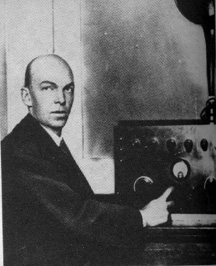
Mit der Radioarbeit The Edwin Armstrong Overture setzt sich der australische Künstler Iolini mit der Anfangsgeschichte des FM Radios auseinander, indem er die tragische Lebensgeschichte von Edwin Armstrong - dem Erfinder von FM Radio darstellt.
Armstrong, der nach jahrelangen aussichtslosem Patentkämpfen mit der Radio Corporation of America (RCA) eines Tages mit Hut, Schal und Mantel seinem Leben ein abruptes Ende setzt.
Für The Edwin Armstrong Overture arbeitete Robert Iolini ausschließlich mit Geräuschen von Kurzwellenradios, Klavier und gesampelten Klaviersounds. Armstrong wird durch das Klavier und die Klaviersamples dargestellt, die RCA/Sarnoff durch die Kurzwellengeräusche.
City in Between
City In Between des australischen Komponisten Robert Iolini in Zusammenarbeit mit dem Saxophonisten Phillip Ma handelt von der Rückgabe Hong Kongs an China am 30. Juni 1997.In die Arbeit City in Between fliessen durch die on site Aufnahmen von Phillip Ma subjektive Erfahrungen und Erwartungen der in Hong Kong lebenden Menschen ein.
Silent Motion
Robert Iolini - Komposition, Sampling, Virgina Baxter - Stimme und Chris Abrahams - Keyboards
In Silent Motion setzt sich Iolini mit Filmmusik und Ihrer Rezeption an Hand von Stummfilmen auseinander. Das Ausgangsmaterial besteht unter anderem aus einem Mix von Originalmusik, Stummfilmmusik und Sound Effekten.
Marking Time
Voices - Amanda Stewart, Michelle Morgan; Saxophones, flutes, flax - Jim Denley; Saxophon, electric guitar and bass, violin - Phillip Ma; Midi guitar and sampler - Robert Iolini
Marking Time ist eine musikalische Auseinandersetzung mit Apokalypsen. Jenem Vokabel, das mittlerweile inflationär für alles und jedes werwendet wird, was uns in Zukunft und Gegenwart Angst und Schrecken einjagen soll. Von der Milleniumsapokalypse in die Wetterapokalype.
Stimmen in diesem Stück sind Michelle Morgan und Amanda Stewart. Alto-Saxophon und Flöte Jim Denely, Saxophon, Gittarre, Bass und Violine Phillip Ma, Komposition und Bearbeitung Robert Iolini.
Alle Arbeiten wurden für die Radiokunstreihe "The Listening Room" des Australischen Rundfunks ABC produziert. |
english
The Edwin Armstrong Overture
Recorded at ABC studios Ultimo, Sydney,1997 Released on The Listening Room CD 'DoubleExposure' 1998
The work was commisioned by the ABC radioarts program The Listening Room. It had its first broadcast on 17th November, and has had manysubsequent broadcasts. The piece is composed entirely of shortwave radio, grand piano and treated piano samples. These sonic materials can be perceived as having arepresentational function. The piano and its derivative samples representing Armstrong, the various shortwave samples, RCA/Sarnoff. The narrative is realised through the music alinteractions between these two sonic groups.
Edwin Armstrong was the inventor of the frequency modulation (FM) system.The basis for almost all radio, radar, and television reception. His story is one of genius, obsession, betrayal and tragedy. After inventing FM, Armstrong had a vision of replacing the inferior AM system with the far superior FM. Unfortunately, the Radio Corporation of America had other plans. Even though they had funded Armstrong's research, RCA decided it would be unprofitable for them to switch from AM to FM. And so began the endless legal battles over patents, between Armstrong and RCA. Even when RCA developed television, which relied on FM for its reception and transmission, they refused to pay Armstrong his rightful royalties. Twenty-three years to the day after patenting FM, exhausted and out of hope, frustrated by all the litigation, Armstrong put on his hat, coat, scarf and gloves and walked out of his apartment window, 13 floors to his death.
City in Between
Composition, sample edting and performance by Robert Iolini and Phillip Ma
1997 has become a focus a cause, a point in space a date to live by. At midnight of June 30 1997, the British colony of Hong Kong reverted to Chinese sovereignty. As the 'Pearl of the Orient' however, it is a jewel that must be both incorporated into the body of China, and sealed off from it. The political and public ritual of the handover has been well documented.
City in Between transforms into music and sound, the more subjective experiences and ambiguities experienced by Hong Kong people. The work is based on field recordings made by Phillip Ma, who was in Hong Kong conducting research on Hong Kong emigration. Robert Iolini has collaborated with Phillip to create a work in which Hong Kong voices and sounds, transmuted by sampling, manipulated as elements for further improvisation and composition, trace the trajectory of a city and people whose destiny remains unknown.
Silent Motion
Composition, sample edting and performance by Robert Iolini
With: Virginia Baxter - voice, Chris Abrahams - additional keyboards
Produced at ABC studios Ultimo, Sydney,1998
The work was commisioned by the ABC audio arts program The Listening Room. "Silent Motion is a lyrical, critical, and often amusing guide to society's expectations as to the proper place of music in film. Focusing on the silent film era as an historical juncture which all but sealed the fate of film scoring, the composer adjusts the lense and turns up the volume to assert music's potential as more than just a supporting player.
The composition is a mix of original music, silent film music, period writings, and sound effects, Silent Motion lampoons those who would set up hierarchies in art."
Marking Time
Voices - Amanda Stewart, Michelle Morgan; Saxophones, flutes, flax - Jim Denley;Saxophon, electric guitar and bass, violin - Phillip Ma; Midi guitar and sampler - Robert Iolini;
In a word constantly on the brink of, and undergoing, minor and major
apocalypses, the periods before and after the new millennium act as focal
points.
Marking Time was created through a process of digitally recording directed
improvised performances then editing and recomposing fragments of each of
the artists performances. The result is a new artificially constructed
ensemble performance. |